Sunday, November 7, 2010

Split & Korcula, Croatia

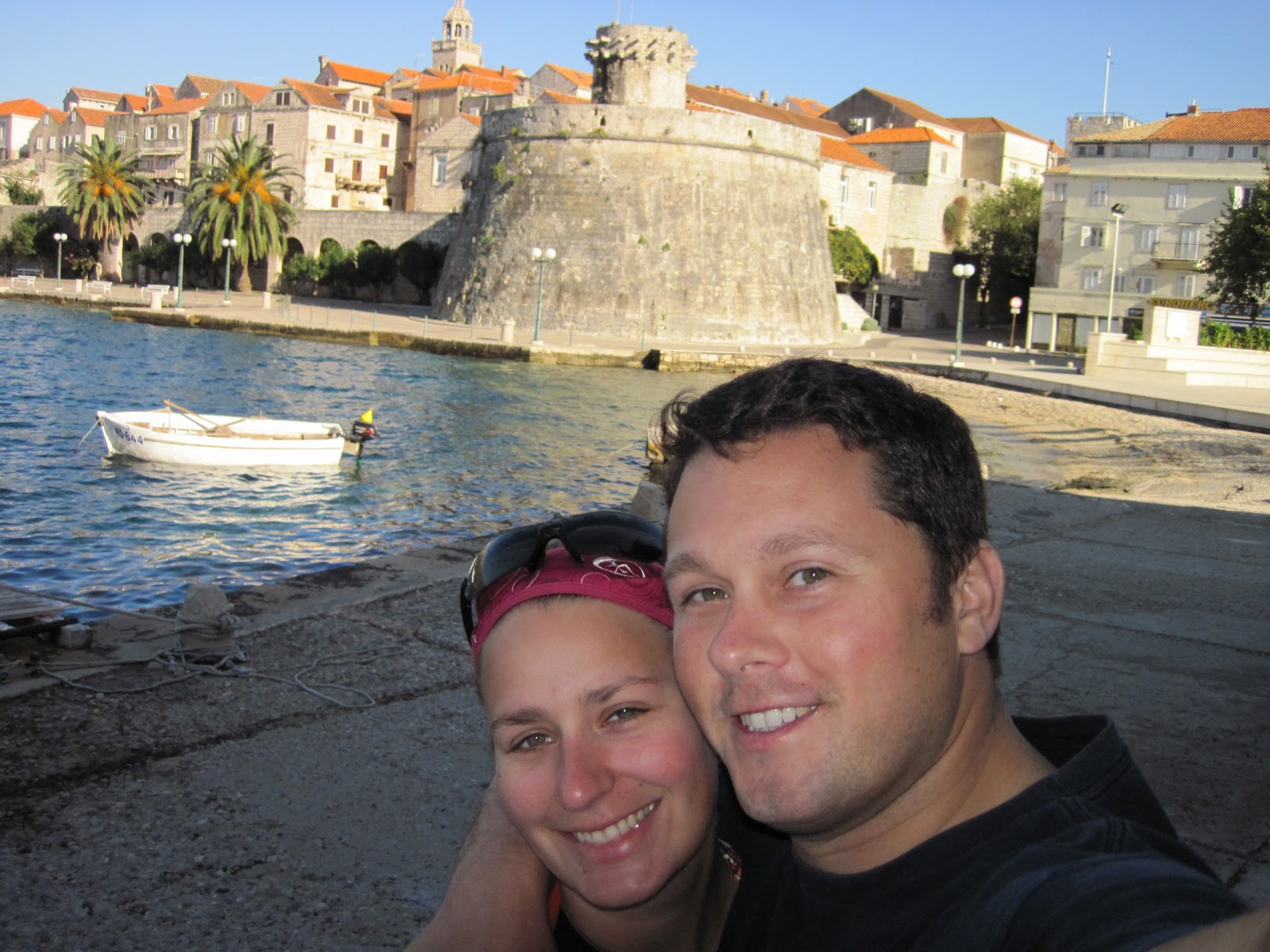
We left Budapest by train to Croatia.  We entered the European Union way back in Iceland and haven’t received any stamps in our passports since that time.  Well, we got both an exit stamp out of Hungary and an entrance stamp into Croatia!  How exciting!  The train brought us into Zagreb, where we stayed the night a little hostel.  In the morning, we took another train to the coast of Croatia to a little city called Split. Diocletian’s Palace is in the city center.  Some parts of the Roman palace are still standing, some areas have been rebuilt, and the areas that are in ruins the modern city has just been built on top.  We took a city bus to an area called Solin which was the capital of the Roman province during the time of Julius Caesar.  There is a huge archaeological area in Solin where there are ruins of the old Roman city.  There are ruins of churches, bath houses, an amphitheater, and other buildings. We found the sun here too on the coast of Adriatic sea.  Its definitely warmer here than the areas of Europe we’ve seen!
After several days in Split, we took a two hour ferry ride to the island of Korcula.  It is currently the low season here so we might be the only tourists in town!  We have  rented a really cute little apartment and have enjoyed our time here very much.  The apartment has a fish tank with two fish in it.  It’s been nice to have some little pets again even if it is for just a couple of days. Korcula has lots of vineyards and olive tree groves on the island.  We bought several bottles of wine last night and drank it on the old stone wall looking over to the other islands.  We really enjoyed being on island time! 
What’s next?  We take a ferry back to the mainland this afternoon.  From there we are taking a bus to Zadar, another coastal town, for one night.  Then we head back to Zagreb to catch a train to Venice, Italy.  We are going to jump on a cruise ship in Venice and cruise around the Greek Islands for 12 days.  Life is great!

Above the hill in Split

Old town Split

Our street in Korcula

Old Town Korcula

Our pet fish in our Korcula apartment

Wednesday, November 3, 2010

Budapest, Hungary

Go time for Budapest.  What’s the best way to save time and money, how about a deluxe overnight train that leaves Krakow at 10 pm and gets you into Budapest at 9.  I expected to arrive feeling rested and refreshed after a tranquil night of slumber, lulled by the rhythmic clickity-clack of the train as we smoothly passed through the quiet Polish-Hungarian countryside.   So my predicted journey was pretty far from reality.  We ended up in a 6 bunk couchette with 3 other people -5 total.  All of us with large backpacks, no one trusted each other as we were told that there was theft on the sleeper trains as we attempted to shoehorn all of our belongings into the small cabin.  As we realized that we were all travelers with the same fears of theft we formed a weak alliance and loosened our death grip on our belongings and decided to use our bunks for what they were intended for…people not luggage.  Our train broke apart in different towns, so you would be jolted from your sleep by the train coming to a quick stop or by your car being attached to another train going in a different direction. In the middle of the night the conductor woke us up saying we were in Prague…Prague? One of our bunk-mates got up and attempted to depart the train as quietly as possible which does not work in that small of a space.  Moments later we were on our way again only to stop a few hours later in Bratislava to repeat the process.  When we made it to Budapest we were far from rested and refreshed and felt the strong need to remedy the situation.  Enter the Szechenyi Baths.  The baths on the Pest side (Everything on the west side of the Danube River is the Buda side, to the east Pest.  Once separate towns they finally merged and… viola we have Budapest) are heated by thermal springs that sprout out all over the city.  This complex offered a huge variety of ways to relax from saunas, steam baths, warm pools, hot pools, cold pools, and a huge outdoor swimming complex.  Unlike Baden-Baden this facility was not au natural but we went anyways and after 4 hours later we felt human again.  We made our way back towards our apartment, wandering the streets,  grabbed some dinner of traditional Hungarian grub (I had the goulash and T had the chicken papirkash) and brews, then called it a day for some much needed rest and recovery.
The next day we were eager to see the city and after a quick cup of coffee we made our way.   Upon reaching the Danube River we were instantly blown away by the beauty of the city.  Still on the Pest side, which is the beginning of a large plain that extends into Hungary, we looked across the river to the hilly Buda side to see castle and monument topped hills and the “blue” Danube swiftly flowing between.  Overwhelmed by what we saw we needed to form a plan to attempt to take in all in with only one day to do it and once we had our “strategery” we were off.  Heading north on the Pest side we visited the Parliament building and town square checking out various monuments as we went.  In the afternoon we crossed the river to the Buda side and climbed up Castle Hill to visit the walled city and soak up the views of Pest and the other touristy sites as this is where most were located.  The sun began to sink closer to the Buda hills and it was time for our coup de gras, the accent of  Gellert Hill for the best views of the city and an evening splash in the Gellert Baths to soothe our muscles and quiet our barking dogs.  While the baths were not as large as the Szechenyi Baths they were none the less relaxing and all but erased any trace of the 8 miles we walked.  Tired and hungry we made our way back to our apartment on the Pest side, enjoyed the best bowl of goulash soup we’ve had to date, then called it a night.  Tomorrow we head towards Zagreb for a week in Croatia.
Cheers.
               
Inside the Szechenyi Baths

Outside the Szechenyi Baths


Playing in the fountain in the outside pool

Riverfront view of the Parliament

Hungarian Royal Palace at night

Monday, November 1, 2010

Krakow, Poland

We took a train from Warsaw south to Krakow, Poland.  For those of you who have seen the film Schindler’s List by Steven Spielberg, most of it was filmed in Krakow.   The movie was based on a true story of a businessman who saved Jews from the wrath of Nazis during WWII.  We didn’t tour the Schindler factory and museum, but we did take a hour and half bus ride to Auschwitz.  Auschwitz was one of the largest death camps used by the Nazis and was only partially destroyed after the war.  The camp was actually divided into three separate camps.  We first toured Auschwitz I were many of the original buildings still stand.  We were able to see the bunks, toilet facilities, and cells of the prisoners.  In some of the rooms there huge piles of clothes, shoes, suitcases, hairbrushes, and the most shocking, a large pile of hair taking up the hole length of the room, all taken from the prisoners as they entered the camp.  After the two hour tour of Auschwitz I, we took a short 3 km bus ride to the second area of the camp known as Birkenau.  This is what most people think of when they hear the name Auschwitz.  It had over 300 prison barracks holding up to 200,000 people and was where the murder of huge numbers of Jews took place.  The Nazis built railroad tracks into the camp, which are still there, so they could more efficiently off load people into the gas chambers.  When Birkenau was fully operational, there were five gas chambers each with their own crematoria.  Standing at the back of the camp and looking over the vast area, it was horrifying to think of how systematically the Nazis tried to exterminate an entire population of people. 
The next day, we needed something a little bit less an intense, so we jumped on another bus to the Wieliczka Salt Mine.  The salt mine was in operation for over 500 years and is now on the Unesco’s World Heritage List.  The mine is no longer used today, but is now basically one of the coolest tourist traps I’ve seen.  There are statues, chandeliers, and altarpieces all carved out of salt.  One of the biggest and the most impressive of the chambers was the Chapel of the Blessed Kinga.  This room took 30 years  and over 20,000 tons of rock salt was removed to carve out.
Our last day in Krakow, was spent wandering around Old town.  And what European Old town wouldn’t be complete without a tour of the castle and a church?  Wawel Castle sits onto top of hill and we toured the State rooms and the Crown Treasury & Armory.  Unlike the other castles we have visited during our travels, this one had a Dragon’s Den with a fire breathing dragon!  We also visited the 14th century St Mary’s Church.  My opinion is that it was the most beautifully ornate church we’ve seen on our trip.  The focus of Old town is Rynek Glowny.  It is Europe’s largest medieval town square, and at its centre is the 16th century Renaissance Cloth Hall.
While we were in Krakow, we ate some really good Polish food.  Besides piergos and kielbasa, we had wonderful onion soup and a traditional potato pancake topped with a mushroom cream sauce at a cute little restaurant.  We actually went there twice it was so good!  There was a little bakery just downstairs from the apartment we were in where we would get fresh bread and pastries every morning.  On our last night we ate at a bar mleczny (milk bar).  These little cafeteria style restaurants are leftover from the communist era and they serve traditional foods more or less.  I had a wonderful garlic soup and J had the sour soup which actually was really good despite its name!  After eating our dinner, it was time to head to the train station to take the night train to Budapest.  It should be interesting!
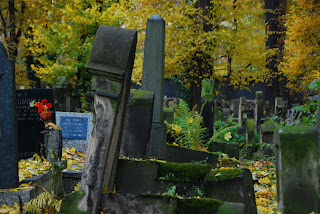
New Jewish cemetary
Pile of shoes at Auschwitz

Railroad tracks and Birkenau gate from the middle of the camp

Chapel in the salt mine


Fire breathing dragon outside his den